Description
Plinia sp. “Pernambuco” — an extraordinary red-and-green cauliflorous Plinia from a highly restricted Brazilian population
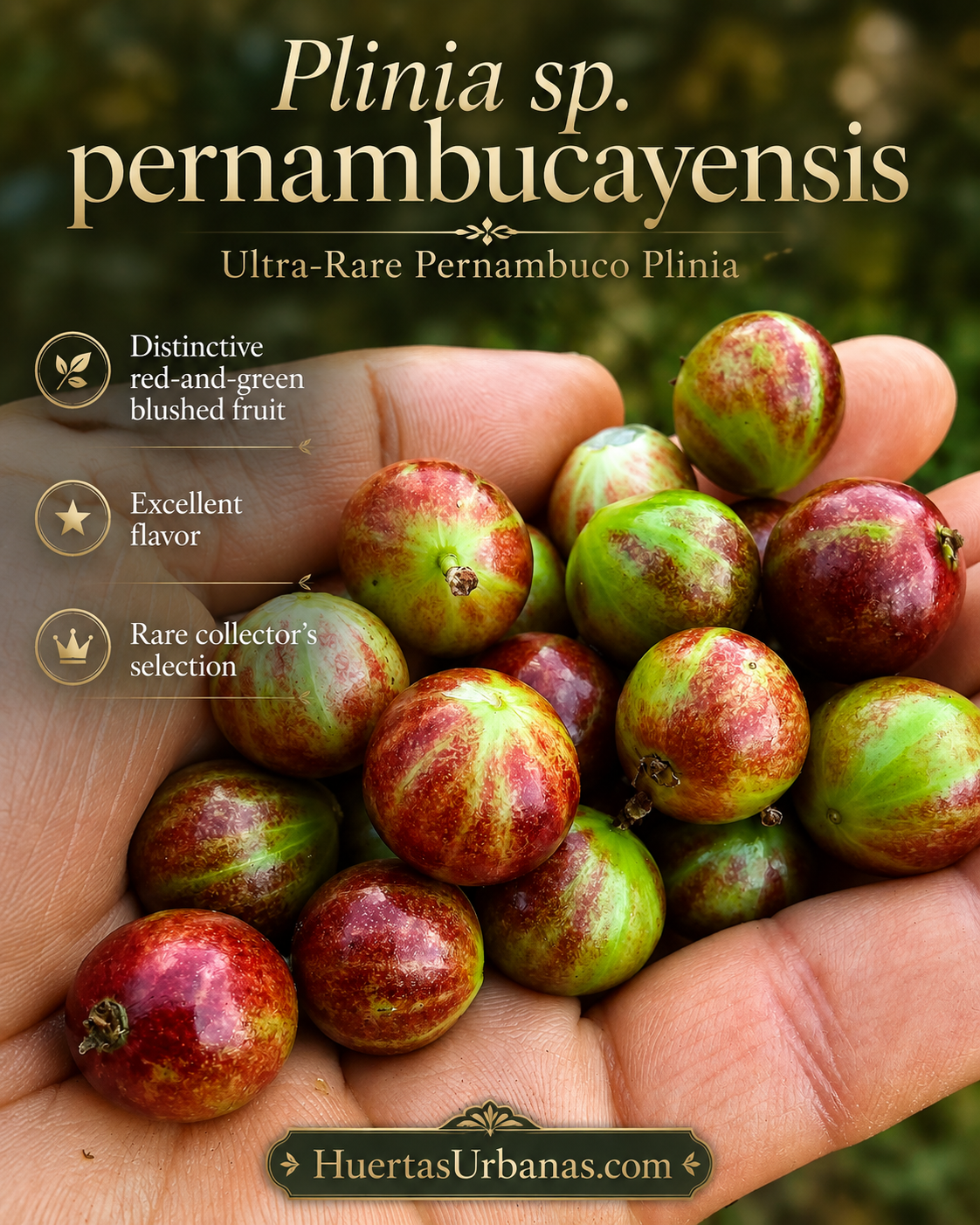
This is one of the most important collector accessions in our September 2026 release: an unidentified Plinia from Pernambuco, Brazil, producing exceptionally distinctive fruits directly on older woody growth.
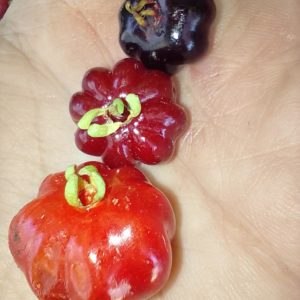
The fruits develop intense red to reddish-purple coloration while retaining conspicuous green areas, streaks or irregular zones even as they approach maturity.
According to our Brazilian network of collectors and field contacts, the fruit has an excellent, intense and memorable flavor.
Its extraordinary coloration, cauliflorous presentation, highly localized origin and restricted collection history make this material far more than another unidentified Plinia. It represents a genuinely unusual accession that appears to remain almost entirely absent from international cultivation.
What makes this Plinia remarkable
- Extraordinary fruit coloration: Red to reddish-purple skin with persistent green zones and markings.
- Cauliflorous fruiting: Fruits are produced directly on older branches and woody growth.
- Reported flavor: Excellent, intense and memorable.
- Origin: A highly localized population in Pernambuco, Brazil.
- Collector access: Collection material became available only after an extended process of communication and trust.
- International circulation: Not known to be circulating through the ordinary international rare-seed market.
- First public release: Only five seeds have been offered in this initial test.
Fruit characteristics
The fruit is visually unlike the more familiar uniformly purple, red or black jaboticaba types.
Its developing surface combines several colors:
- Green in the earlier stages.
- Bright red as pigmentation develops.
- Reddish-purple tones closer to maturity.
- Persistent green sections or irregular traces that remain visible against the red background.
This uneven coloration appears to be a natural characteristic of the accession rather than merely the result of incomplete ripening.
The fruits are borne directly on older woody growth, creating the dramatic cauliflorous presentation especially valued by collectors of Plinia and related jaboticaba species.
The available reports describe the flavor not merely as pleasant, but as strong, excellent and particularly memorable.
A highly restricted collector history
This accession did not come from a commonly cultivated tree, a commercial nursery or material already circulating among seed sellers.
Our Brazilian network reports that access to the source material was highly restricted. The connection to the population was established through a biologist and required a prolonged period of communication and relationship-building before collection material became available.
This history is included as valuable provenance information. It should not be interpreted as a claim of formal worldwide exclusivity.
Nevertheless, based on the information currently available, this appears to be a highly localized Pernambuco accession with extremely limited representation in cultivation.

Identification status
The exact botanical species has not yet been formally confirmed. We are therefore offering this material under the conservative geographic accession name Plinia sp. “Pernambuco”.
The provisional expression “pernambucayensis” has occasionally been associated with the material by members of the collector network. However, we are intentionally not presenting it as a formally published botanical name or as evidence that the plant represents a scientifically described new species.
A more precise identification will require further study of:
- Flowers and flowering structure.
- Leaves and new growth.
- Bark and mature plant architecture.
- Fruit and seed morphology.
- Multiple plants grown to maturity.
Growers should preserve the full accession name Plinia sp. “Pernambuco” in their cultivation records until the material can be studied more completely.
Seed-grown plants may display natural variation in fruit color, size, flavor, growth habit and other characteristics.
Why this accession is especially valuable
- Extraordinary combination of red, reddish-purple and persistent green fruit coloration.
- True cauliflorous presentation on mature woody growth.
- Excellent and intense flavor according to field reports.
- Highly localized Pernambuco provenance.
- Restricted access through a specialized Brazilian collection network.
- Strong botanical value as an unidentified regional Plinia.
- Exceptional horticultural and ornamental potential.
- Possible first-generation international cultivation material.
- Only five seeds released in the first public offering.
For serious Plinia collectors, the value of this accession lies not only in its rarity. It combines a remarkable fruit pattern, excellent reported eating quality, cauliflorous growth and documented provenance from a difficult-to-access Brazilian population.
September 2026 pre-sale
SEPTEMBER 2026 PRE-SALE ITEM
This listing belongs to our September 2026 Brazilian rare-seed collection. Orders containing September pre-sale items will be prepared with the corresponding September batch.
Final availability and shipping timing depend on fruit maturation, the number and condition of seeds actually collected, transport to Argentina, phytosanitary preparation, inspection and international logistics.
Only five seeds are being released in this initial public test.
If the final number of viable seeds is lower than expected, orders will be fulfilled according to payment date and any unfulfilled portion will be refunded.
Because access to the population is highly restricted and seasonal production is uncertain, future availability cannot be assumed.
Germination and early care
Fresh tropical Myrtaceae seeds should be planted promptly and should not be intentionally dried.
- Sow shallowly in a loose, organic and well-draining medium.
- Keep the substrate consistently moist, but never stagnant or waterlogged.
- Maintain warm conditions, ideally around 24–28°C / 75–82°F.
- Provide bright shade or filtered light during germination and early growth.
- If a seed arrives already rooted, position the root carefully downward without bending or breaking it.
- Protect young seedlings from intense afternoon sun, cold wind and frost.
- Increase sunlight gradually after the seedlings become established.
Fresh Plinia seeds are recalcitrant and may lose viability if allowed to dry excessively. Slight germination or root development during transit is natural and should not automatically be considered a defect.
Germination cannot be guaranteed because viability is affected by natural variation, fruit maturity, handling, transit time and the buyer’s growing conditions.
With its extraordinary red-and-green cauliflorous fruits, excellent reported flavor, highly restricted Pernambuco provenance and an initial public release of only five seeds, Plinia sp. “Pernambuco” is one of the rarest and most significant accessions in our September 2026 collection.
Reviews
There are no reviews yet.