Description
A Rare Sweet Annona from Espírito Santo — Probably Annona cf. dolabripetala
This remarkable Annonaceae accession comes from Espírito Santo, southeastern Brazil, and has been maintained under the collector’s working name Annona sp. “Doce do Espírito Santo”.
Following comparison with botanical literature, herbarium records and documented material from Espírito Santo, this accession now appears to be strongly consistent with Annona dolabripetala Raddi.
Because we have not yet examined flowers or complete diagnostic botanical material from the mother plant, we prefer to maintain a conservative identification as:
Annona cf. dolabripetala — “Doce do Espírito Santo”
The abbreviation cf. (“compare with”) indicates that the material appears to correspond closely to this species but that the identification has not yet been independently confirmed.
Striking Sculptured Golden-Yellow Fruits
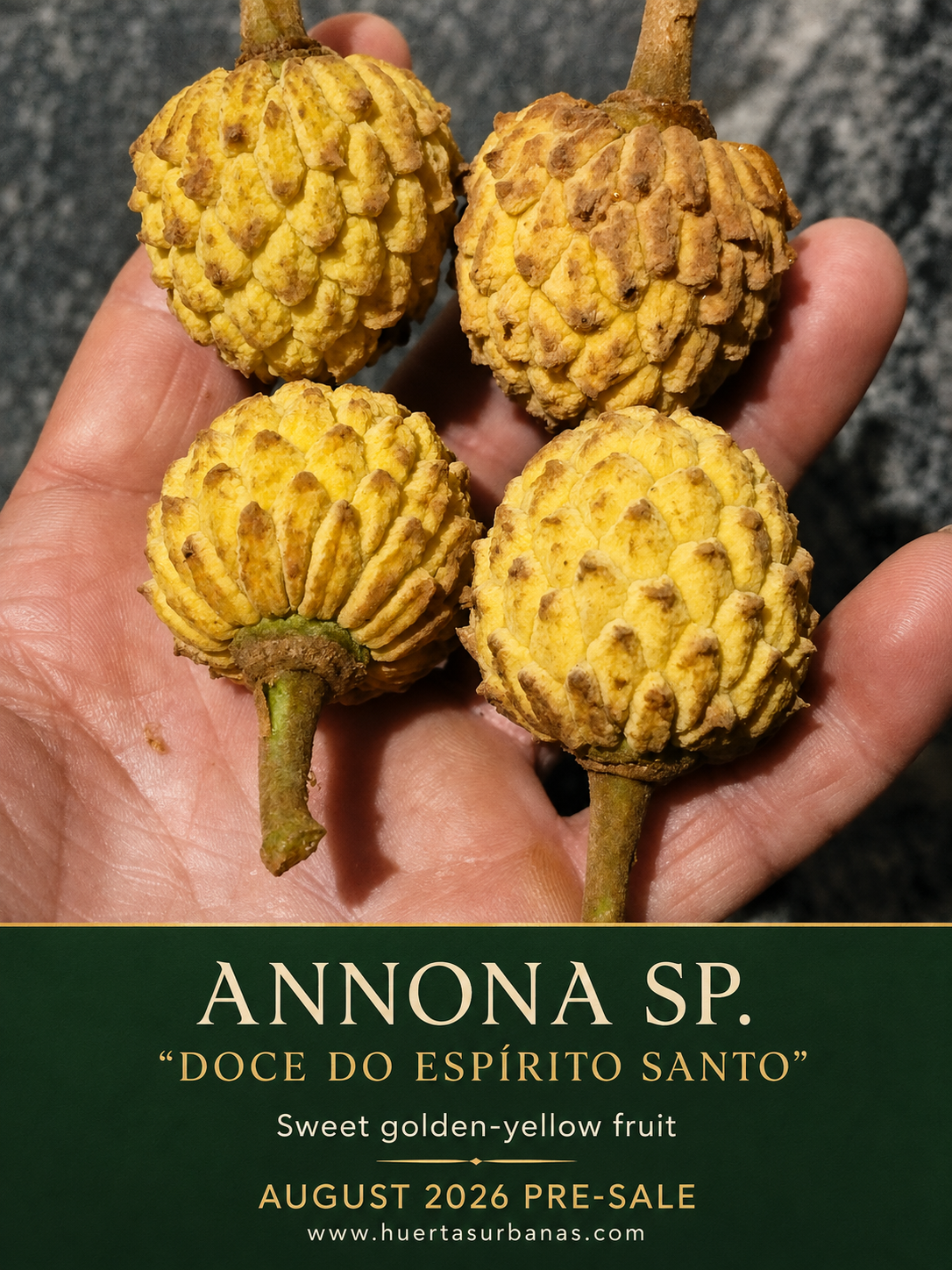
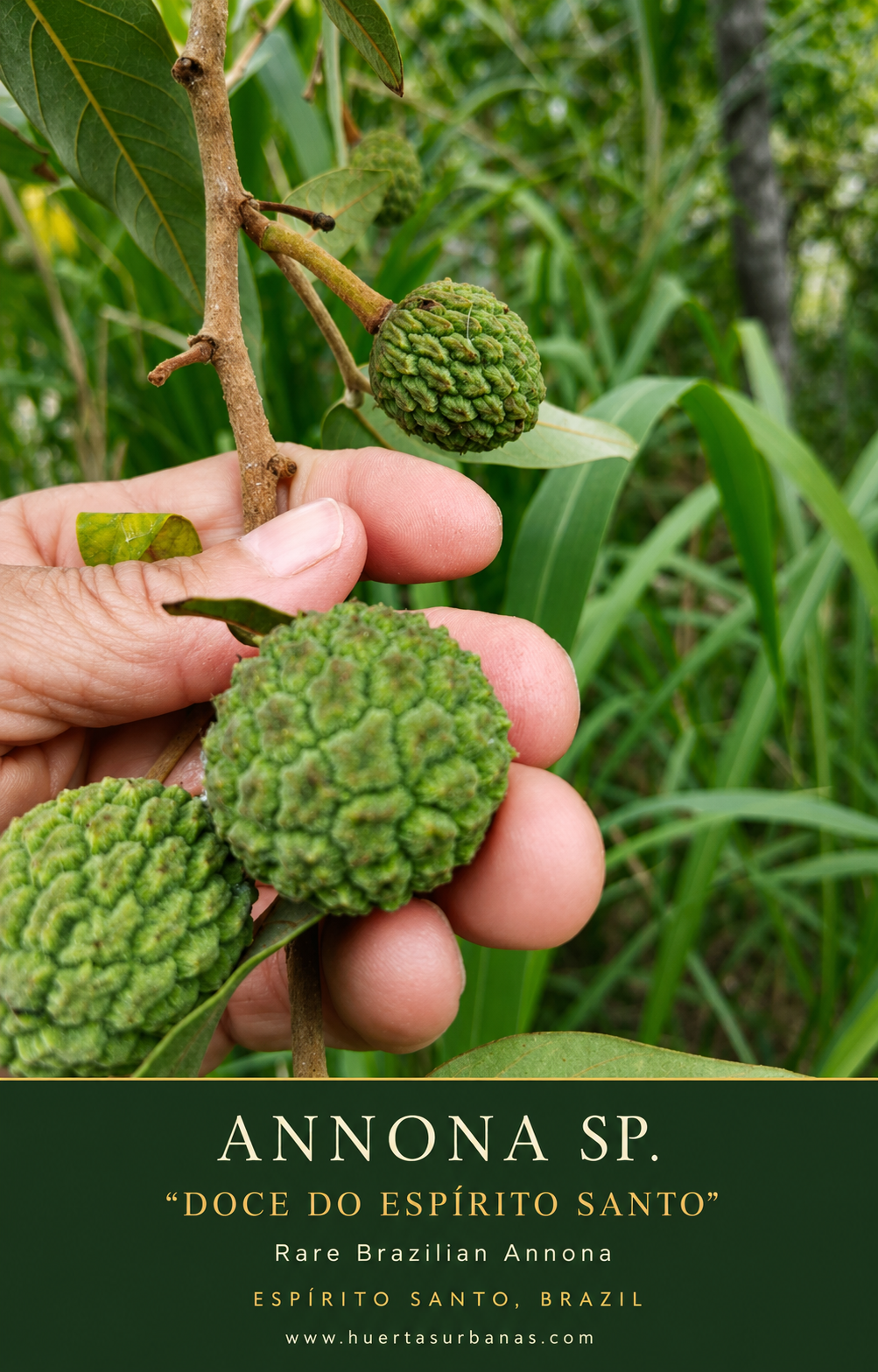
The fruits are highly distinctive. While immature they are green, gradually turning an intense golden yellow as they ripen.
The surface is formed by numerous pronounced and irregular carpel segments, giving the fruit an unusually sculptured, almost prehistoric appearance.
This morphology is particularly interesting in relation to Annona dolabripetala, a native Brazilian species documented from Espírito Santo and characterized by strongly differentiated carpels in the mature fruit.
The ripe fruits shown in our photographs are the actual seed-source material associated with this release.
Selected for Sweet Flavor
The material was originally supplied under the collector name “Doce do Espírito Santo”, referring to both its reported sweet eating quality and its origin in the Brazilian state of Espírito Santo.
Descriptions of Annona dolabripetala also report edible sweet pulp and yellowish fruits at maturity, providing another interesting point of agreement with this accession.
Because we currently do not have photographs of a cut fruit or a detailed pulp analysis from this particular mother tree, we prefer not to invent additional flavor notes or make exaggerated claims.
What we can confirm is that this accession was specifically selected and supplied as a sweet-fruited Annona.
Probable Botanical Identity — Annona cf. dolabripetala
After the original release of this accession as an unidentified Annona, additional comparison with taxonomic references suggested a particularly interesting possibility: Annona dolabripetala Raddi.
This species is documented from several localities in Espírito Santo, including Atlantic Forest areas of southeastern Brazil.
Several visible characteristics of our seed-source material are consistent with this identification:
- Origin in Espírito Santo, within the documented distribution of Annona dolabripetala.
- Golden-yellow coloration at fruit maturity.
- Strongly sculptured fruit composed of numerous prominent carpel segments.
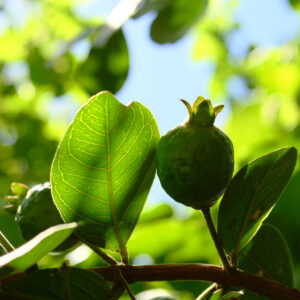
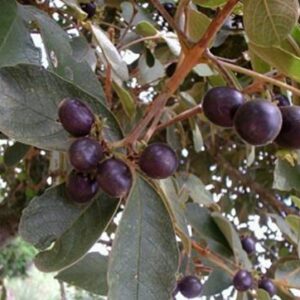
- Relatively narrow foliage visible in the source photographs.
- Fruit borne on a comparatively elongated pedicel.
- Reported sweet edible pulp.
Particularly notable is the appearance of the mature fruit, whose prominent and somewhat elongated carpels closely resemble documented fruits of Annona dolabripetala.
However, species-level identification within Annonaceae should ideally include flowers and additional vegetative characters. Flowers of A. dolabripetala provide important diagnostic features that are not currently available from our source plant.
For that reason, we consider the most scientifically responsible designation at present to be:
Annona cf. dolabripetala Raddi — “Doce do Espírito Santo”
rather than presenting the species identification as completely confirmed.
If additional botanical material becomes available in the future—including flowers, detailed photographs of both leaf surfaces, young branches, seeds or herbarium-quality specimens—we will continue refining the identification.
Why This Accession Is Special
- Rare native Brazilian Annona from Espírito Santo.
- Probably Annona dolabripetala, pending final botanical confirmation.
- Reportedly sweet edible fruit.
- Beautiful golden-yellow coloration when ripe.
- Extremely sculptured fruit with prominent carpel segments.
- Excellent provenance for collectors of Brazilian Annonaceae.
- Only 12 seeds obtained for this entire batch.
- Excellent collector material for rare-fruit and Annonaceae growers.
August 2026 Ultra-Limited Pre-Sale
This is part of our August 2026 rare seed release. Availability is exceptionally limited and future collections cannot be guaranteed.
Orders containing this item will be prepared with the corresponding August batch. Customers combining seeds from different pre-sale periods may require a split shipment to preserve seed quality.
Germination
- Sow the seeds as soon as possible after arrival.
- Soaking in clean water for 24–48 hours before sowing is recommended.
- Sow approximately 1–2 cm deep in a loose, well-draining substrate.
- Keep warm, ideally around 24–30°C / 75–86°F.
- Maintain even moisture without permanent waterlogging.
- Germination may be irregular and patience is required with rare Annona species.
Reviews
There are no reviews yet.