Description
Eugenia sp. “Pitanga Acerola” — Spectacular Red Pulp & Fresh Seeds Already Germinating!
🌱 OCTOBER 2026 UPDATE — GERMINATION CONFIRMED!
Wonderful news for rare-fruit collectors! Our September 2026 batch of Eugenia sp. “Pitanga Acerola” has arrived and has been personally inspected. The seeds are in excellent visual condition, and several are already germinating, with healthy-looking roots emerging!
This is especially encouraging for such an unusual Brazilian Eugenia. The seeds also display a fascinating kidney-shaped (reniform) morphology, quite distinctive in appearance.
We have now replenished the available pre-sale stock, giving more collectors an opportunity to reserve this remarkable accession.
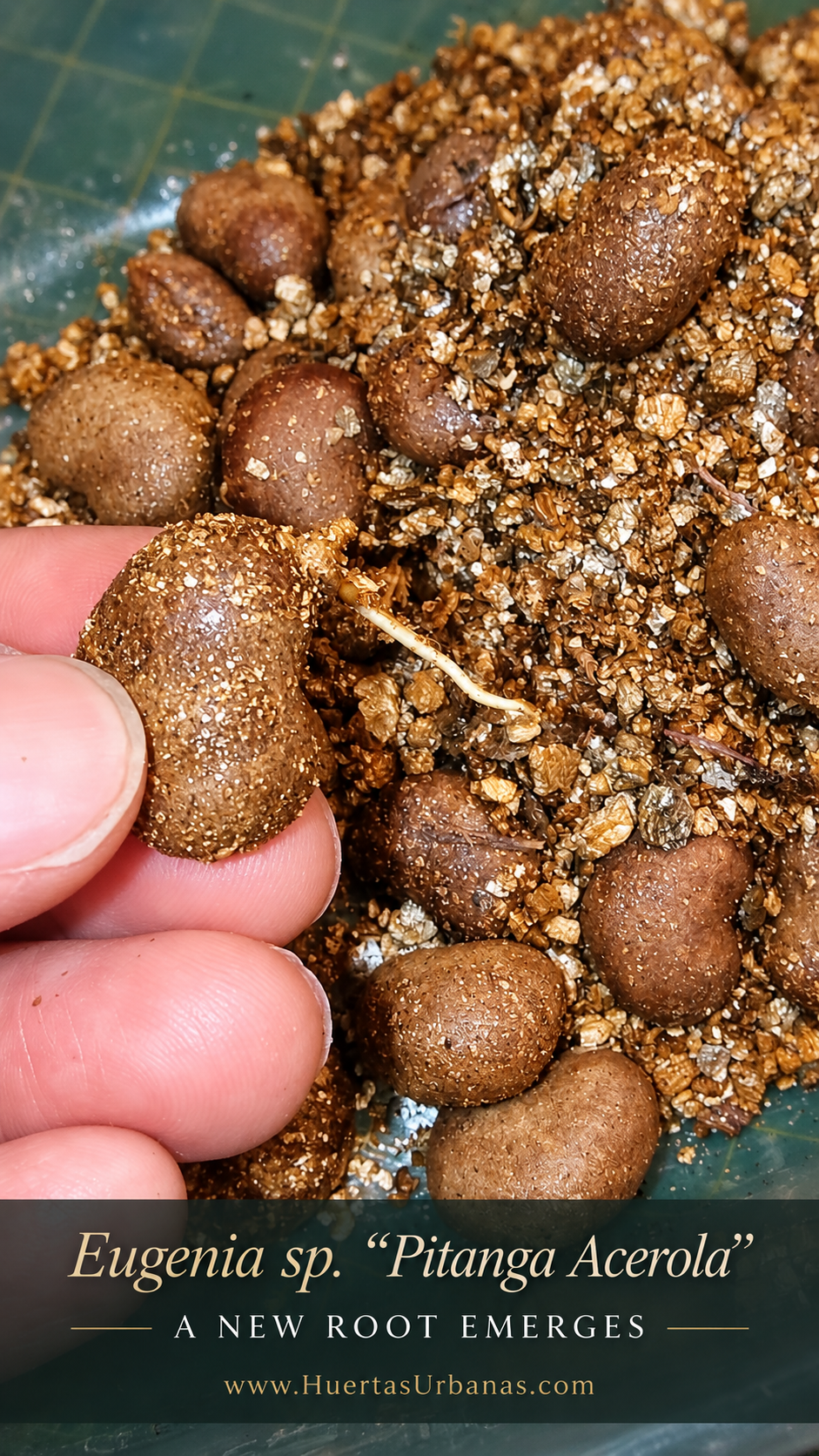
Actual seeds from our September batch. Germination has begun, with roots emerging from several seeds.
🌿 A Rare Brazilian Eugenia with Extraordinary Crimson Flesh
Among the unusual fruit trees in our September collection, Eugenia sp. “Pitanga Acerola” stands out for its dramatic appearance and intriguing reported flavor.
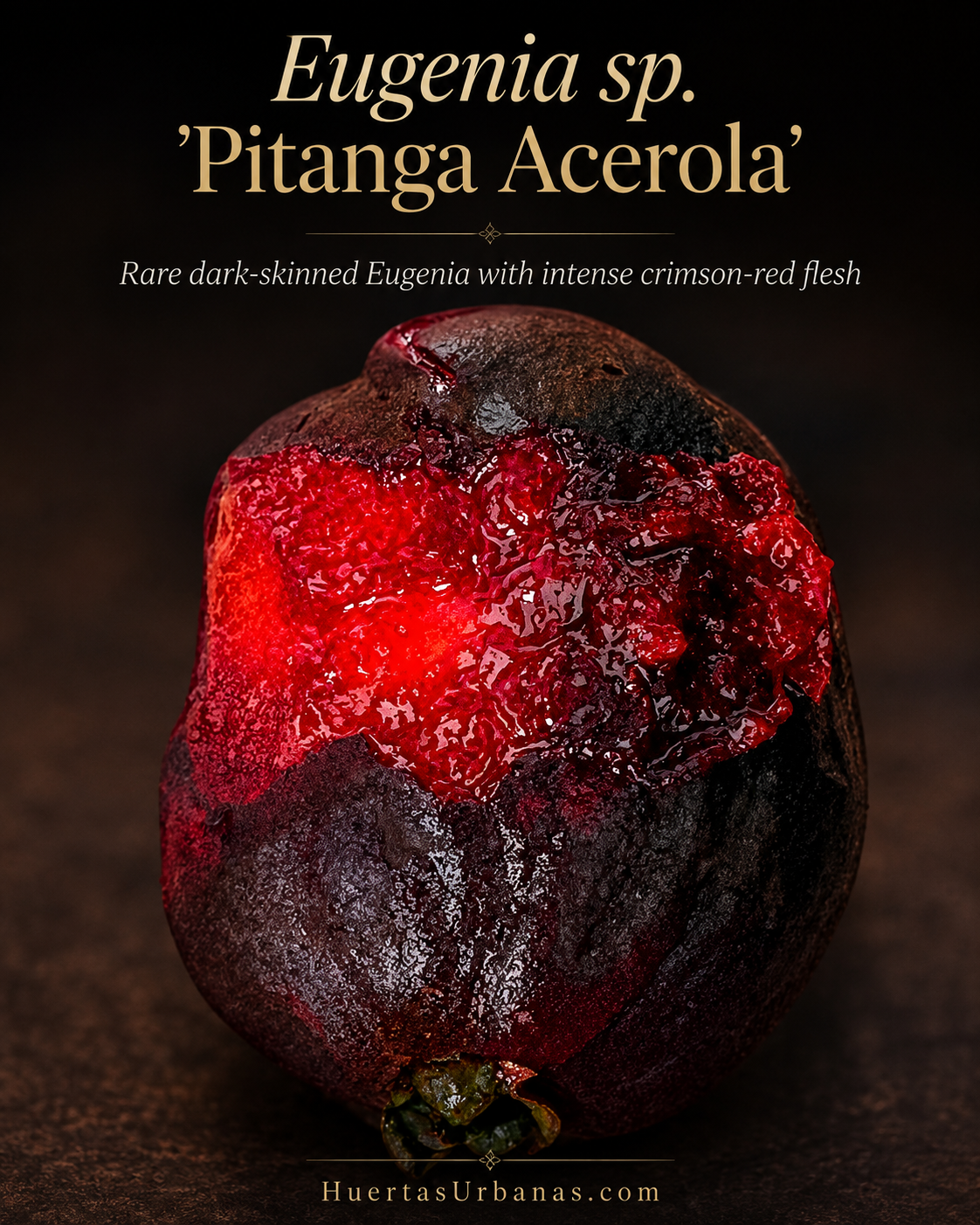
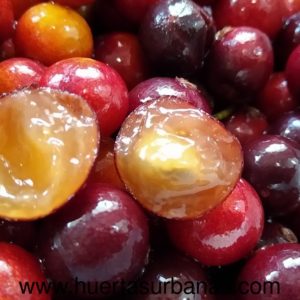
Its fruits develop a deep burgundy to nearly black skin, concealing an unexpectedly brilliant red to crimson pulp.
The contrast is spectacular: a dark, glossy fruit opening to reveal intensely colored flesh.
According to field observations, the fruits can reach approximately 4–6 cm, an impressive size for a fruit with a flavor compared to pitanga.
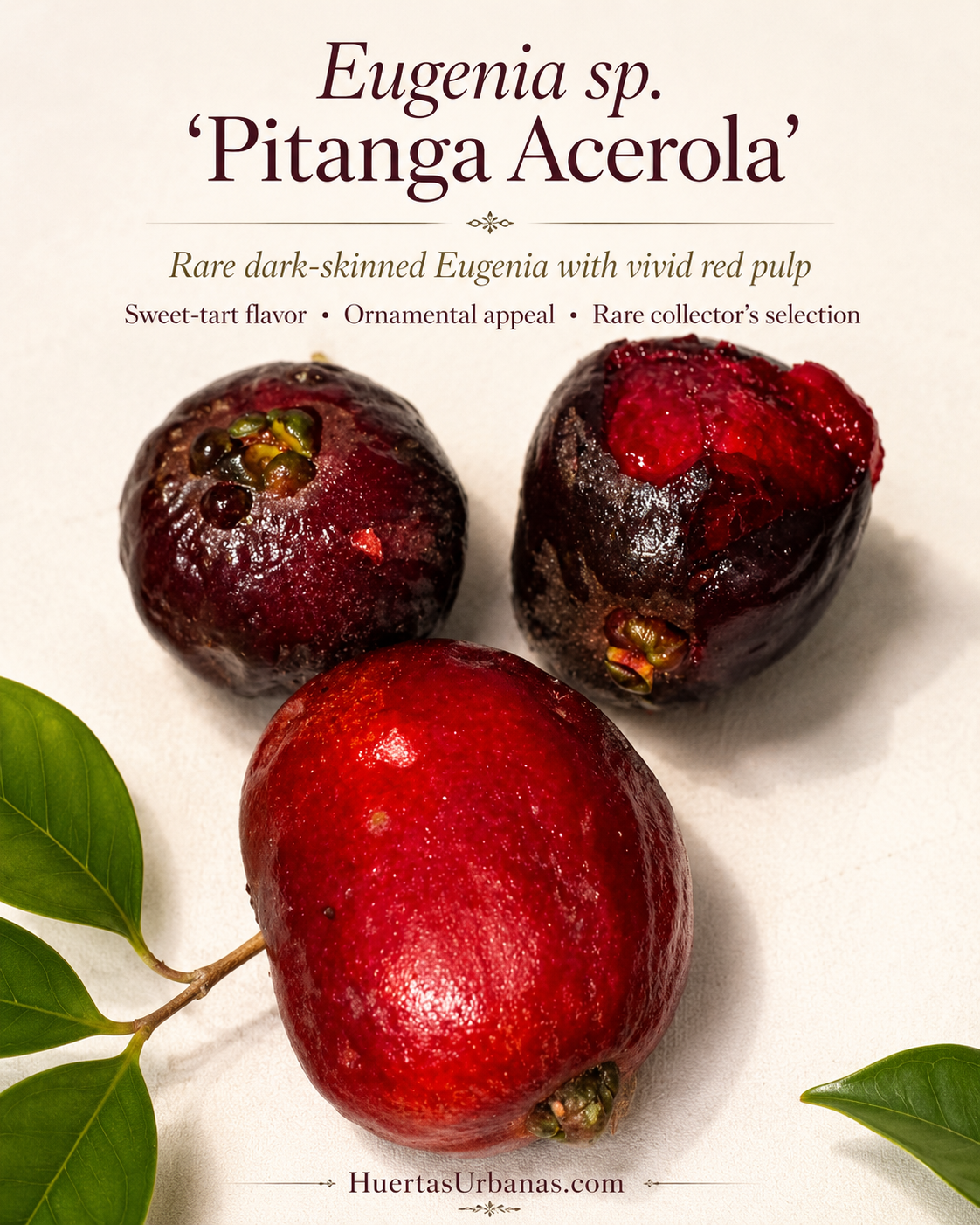
The striking contrast between the dark exterior and vivid-red flesh makes this accession especially attractive to rare-fruit collectors.
🍒 What Does Pitanga Acerola Taste Like?
The flavor has been described by Brazilian collectors as reminiscent of a combination of pitanga and acerola.
This comparison suggests an aromatic fruit with a lively character, potentially combining the distinctive fragrance associated with pitanga and the fresh, bright flavor associated with acerola.
Important: This description is based on collector reports, not an independent tasting by Huertas Urbanas. The name “Pitanga Acerola” refers to the reported flavor and does not imply that this plant is a hybrid.
Fruit and Plant Characteristics
- Botanical identification: Eugenia sp. — species not yet determined.
- Collector name: “Pitanga Acerola” / “Red Pulp”.
- Family: Myrtaceae.
- Origin: Brazilian Atlantic Forest, according to source information.
- Fruit size: Approximately 4–6 cm, as reported from field observations.
- Ripe fruit: Dark burgundy to nearly black.
- Pulp: Vivid red to intense crimson.
- Reported flavor: Aromatic, reminiscent of pitanga and acerola.
- Growth habit: Shrub-sized and tree-sized individuals have been reported.
- Seeds: Substantial, brown, frequently kidney-shaped; germination has been observed in our current batch.
- Availability: Rare collector material, offered in limited seasonal releases.
🌱 Fresh Seed Condition — Personally Inspected
Unlike a pre-sale based solely on an anticipated harvest, our September batch has already been received and inspected in Argentina.
The seeds look excellent, and visible root emergence has now been documented.
This is an important development because tropical Eugenia seeds are generally sensitive to excessive drying and should be handled carefully during storage and transport.
Visible germination confirms that some seeds have begun developing, but it does not establish a germination percentage for the entire batch. Individual results depend on seed condition, transport, handling and growing conditions.
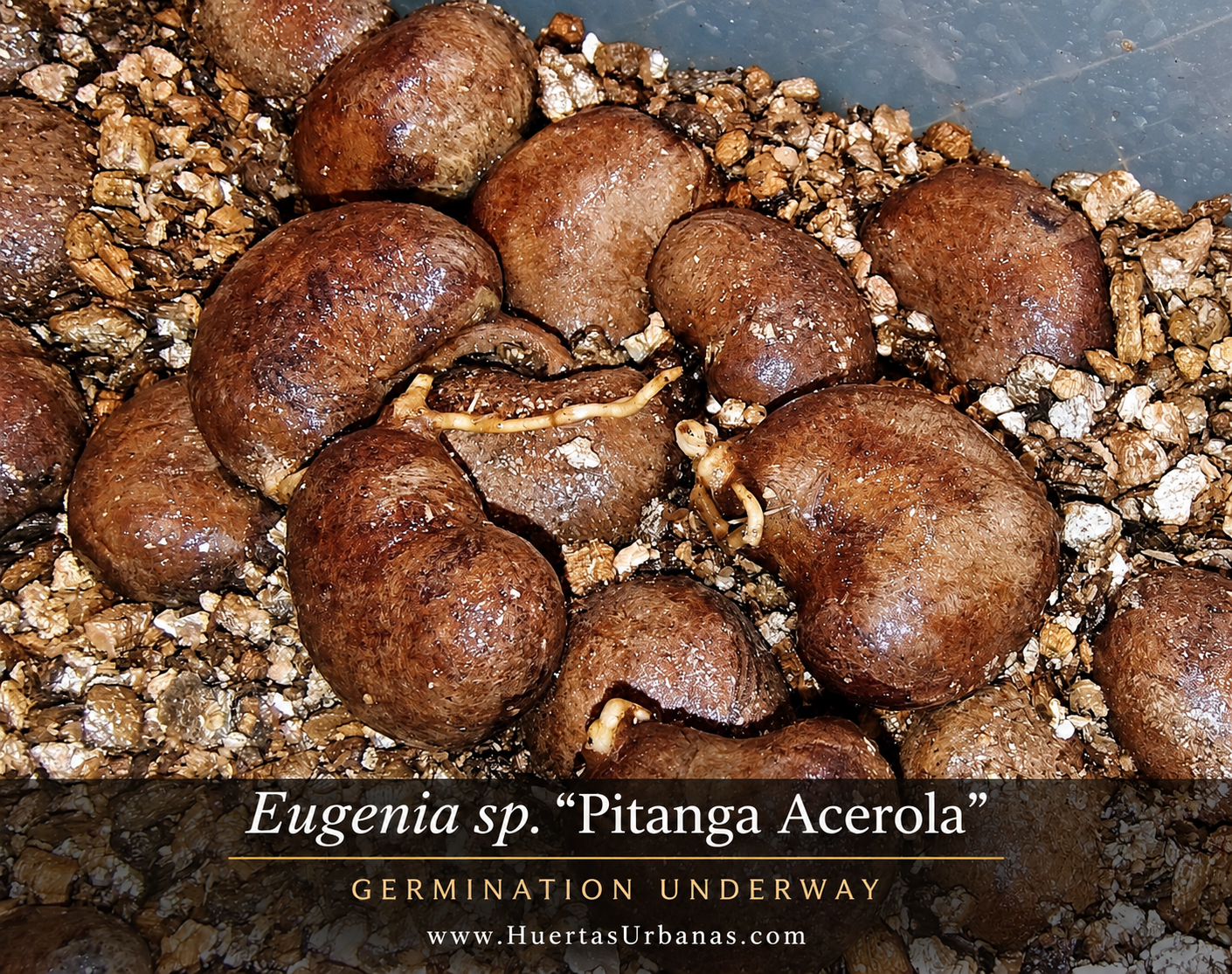
Close-up of the distinctive seed morphology. The combination of unusual shape and observed germination makes this batch particularly interesting.
Why Collectors Should Consider This Eugenia
- Unusual dark fruits with spectacular crimson flesh.
- Relatively large fruits, according to collector observations.
- Intriguing reported pitanga-and-acerola flavor.
- Rare Brazilian Atlantic Forest material.
- Distinctive kidney-shaped seeds.
- Fresh batch already showing visible germination.
- Interesting potential for cultivation, observation and future selection.
As with other seed-grown tropical fruit trees, individual plants may vary in vigor, fruit size, pigmentation, flavor and growth habit.
Botanical Identification — An Important Clarification
The exact species has not yet been confirmed. We therefore offer this accession conservatively as Eugenia sp. “Pitanga Acerola” / “Red Pulp”.
Although “Pitanga Acerola” is an appealing collector name, it should not be confused with a confirmed botanical identification or taken as evidence of hybridization between pitanga (Eugenia uniflora) and acerola (Malpighia emarginata).
A definitive identification would require additional study of flowers, leaves, fruits, seeds and mature plants. We recommend retaining the accession name in cultivation records until its taxonomy can be clarified.
September 2026 Pre-Sale — Fresh Seeds Confirmed
✅ BATCH RECEIVED
✅ SEEDS PERSONALLY INSPECTED
✅ GERMINATION UNDERWAY
✅ ADDITIONAL STOCK RELEASED
This product belongs to our September 2026 pre-sale. The seeds are currently in Argentina and are being prepared for the corresponding international shipment, including the necessary inspection, phytosanitary procedures and logistics.
This is not yet immediate USA stock. Shipping will follow the September batch’s international transport and processing schedule.
Germination and Early Cultivation
Fresh tropical Eugenia seeds should be planted promptly and protected from drying out.
- Substrate: Use a loose, well-draining mixture with good moisture retention.
- Moisture: Keep consistently moist, never saturated or waterlogged.
- Temperature: Warm conditions, approximately 24–28°C (75–82°F), are a reasonable starting point for germination.
- Light: Provide bright indirect light or filtered shade during early development.
- Planting depth: Sow shallowly, with light substrate coverage.
- Already-rooted seeds: Handle emerging roots very gently and avoid forcing or bending them.
- Young seedlings: Protect from frost, strong wind and intense afternoon sun until established.
Because this is an uncommon and incompletely studied accession, the suggested cultivation conditions are general guidance for tropical Eugenia, not a species-specific experimentally validated protocol.
🌱 An exceptional Brazilian Eugenia combining spectacular red-fleshed fruits, unusual kidney-shaped seeds and — most excitingly — confirmed germination in our freshly inspected September batch.
Reserve yours while available!

Reviews
There are no reviews yet.