Description
Eugenia sp. “Brijida” — a large sculpted golden fruit unlike any other accession in this collection
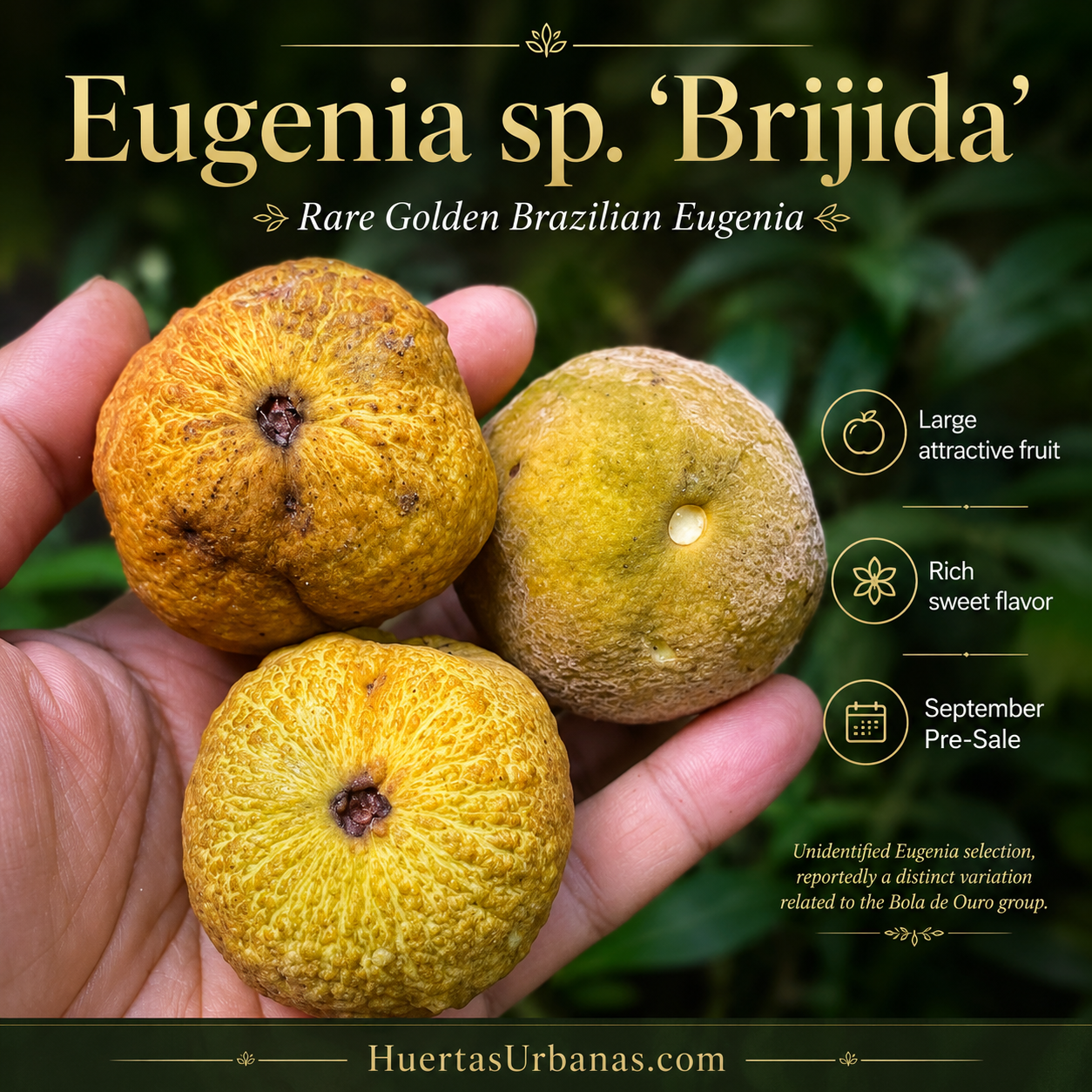
This remarkable Brazilian Eugenia produces large, rounded to slightly flattened fruits with an exceptionally distinctive sculpted surface.
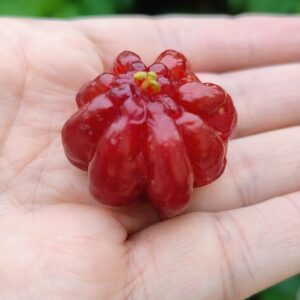
Rather than having the smooth, nearly spherical appearance normally associated with “Bola de Ouro” or “Bola Dourada” types, Brijida develops a rough, reticulated exterior, pronounced surface relief and a clearly depressed apex.
These characteristics give the fruit an unmistakable identity of its own.
According to our Brazilian network of collectors, guides and field contacts, the fruit is sweet and has an excellent flavor. The combination of large size, unusual architecture, distinctive appearance and eating quality makes Brijida one of the most interesting Eugenia accessions in our September 2026 collection.
A rare Eugenia from the interior forests of Bahia
The source plants were found in Bahia, Brazil, growing inside the forest rather than along an easily accessible forest edge.
The observed plants were approximately 3 meters tall and developed a defined crown with relatively few lateral branches.
This field information is especially interesting because it suggests that the source accession may have a naturally manageable architecture compared with many larger forest Eugenias.
The observed height of the source plants should not be interpreted as a guarantee that every seed-grown plant will remain at exactly three meters. Final size will depend on genetics, soil, climate, pruning and cultivation conditions.
Nevertheless, the information provides valuable insight into the form and structure of the original material.
Fruit characteristics
- Shape: Large, rounded to slightly flattened.
- Color: Yellow-green developing toward golden tones.
- Surface: Strongly textured, rough, reticulated and sculpted.
- Apex: Broadly and noticeably depressed.
- Reported flavor: Sweet and excellent.
- Origin: Interior forest habitat in Bahia, Brazil.
- Observed source-tree height: Approximately 3 meters.
- Observed architecture: Defined crown with relatively few lateral branches.
Three golden Eugenias — three distinct accessions
Brijida must not be confused with either the earlier Bola Dourada from Minas Gerais or the new Bola de Ouro from Bahia.
Although all three may produce large yellow or golden fruits, they represent separate source materials with different origins, fruit characteristics and field histories.
Eugenia sp. “Brijida” — Bahia
- Large, rounded to slightly flattened fruit.
- Strongly sculpted, rough or reticulated surface.
- Clearly depressed apex.
- Interior-forest origin in Bahia.
- Source plants observed at approximately 3 meters.
- Sweet and excellent reported flavor.
Eugenia sp. “Bola de Ouro” — Bahia
- Much smoother and more regularly rounded golden fruit.
- Reported fruit size reaching approximately 11 cm.
- Very sweet flavor according to field reports.
- Origin in a highly localized Bahia restinga population.
- Source plants observed as relatively small trees or large shrubs.
- Reportedly known from only one collection location.
Eugenia sp. “Bola Dourada” — Minas Gerais
- The earlier highland golden-fruited accession from Minas Gerais.
- Maintained under the corrected name Bola Dourada.
- Different geographic origin from both Bahia accessions.
- Separate collection history and genetic provenance.
- Must not be relabeled as Bola de Ouro or Brijida.
These distinctions are important because visually related Brazilian Eugenias can easily become mixed or incorrectly renamed once seedlings enter cultivation.
Growers should preserve the complete accession names in their records:
- Eugenia sp. “Brijida” — Bahia.
- Eugenia sp. “Bola de Ouro” — Bahia.
- Eugenia sp. “Bola Dourada” — Minas Gerais.
Why Brijida deserves its own accession name
Brijida is not being separated merely because it came from a different tree.
Its fruit morphology is visibly distinctive:
- The surface is much more deeply textured and sculpted.
- The fruit is less perfectly spherical.
- The apex is prominently depressed.
- The source plants show a documented interior-forest origin and particular crown structure.
These differences justify maintaining Brijida independently while its exact botanical identity is investigated.
It may ultimately prove to be related to other large golden Eugenias, but similarity does not establish that the accessions belong to the same species, variety or genetic population.
Identification status
The exact botanical species has not yet been confirmed.
“Brijida” is preserved as the accession name supplied through the Brazilian collector network, and the material is offered honestly as Eugenia sp. “Brijida”.
It should not yet be treated as a formally described botanical species, registered cultivar or scientifically confirmed variation of Bola de Ouro.
A more precise identification will require examination of:
- Flowers and flowering structure.
- Leaves and new growth.
- Fruit and seed morphology.
- Bark and mature plant architecture.
- Multiple seed-grown plants cultivated to maturity.
Seed-grown plants may display natural variation in fruit size, color, texture, flavor, productivity and growth habit.
Please preserve the complete name Eugenia sp. “Brijida” — Bahia in cultivation records.
Why this accession is especially valuable
- Large fruit with an exceptionally sculpted and reticulated surface.
- Distinctive flattened form and depressed apex.
- Sweet and excellent flavor according to field reports.
- Rare interior-forest provenance from Bahia.
- Relatively small source trees observed at approximately 3 meters.
- Interesting crown-forming architecture with few lateral branches.
- Clearly distinguishable from Bola de Ouro and Bola Dourada.
- Strong botanical, horticultural and ornamental value.
- Excellent potential for collectors, nurseries and future fruit selection.
Brijida is especially important for collectors who value not only rarity, but also clearly recognizable fruit morphology and carefully preserved provenance.
September 2026 pre-sale
SEPTEMBER 2026 PRE-SALE ITEM
This listing belongs to our September 2026 Brazilian rare-seed collection. Orders containing September pre-sale items will be prepared with the corresponding September batch.
Final availability and shipping timing depend on fruit maturation, the number and condition of seeds actually collected, transport to Argentina, phytosanitary preparation, inspection and international logistics.
Only a limited initial quantity is being released.
If the final number of viable seeds is lower than expected, orders will be fulfilled according to payment date and any unfulfilled portion will be refunded.
Because this material comes from a rare and seasonally collected source accession, future availability cannot be assumed.
Germination and early care
Fresh tropical Myrtaceae seeds should be planted promptly and should not be intentionally dried.
- Sow shallowly in a loose, organic and well-draining medium.
- Keep the substrate consistently moist, but never stagnant or waterlogged.
- Maintain warm conditions, ideally around 24–28°C / 75–82°F.
- Provide bright shade or filtered light during germination and early growth.
- If a seed arrives already rooted, position the root carefully downward without bending or breaking it.
- Protect young seedlings from intense afternoon sun, cold wind and frost.
- Increase exposure to direct sunlight gradually after the plants become established.
Fresh Eugenia seeds are recalcitrant and may lose viability if allowed to dry excessively. Early root development during transit is natural and should not automatically be considered a defect.
Germination cannot be guaranteed because viability is affected by natural variation, fruit maturity, handling, transit time and the buyer’s growing conditions.
With its large sculpted golden fruit, deeply textured surface, depressed apex, excellent reported flavor and clearly documented distinction from both Bola de Ouro and Bola Dourada, Eugenia sp. “Brijida” is one of the most visually recognizable and horticulturally promising accessions in our September 2026 collection.
Reviews
There are no reviews yet.