Description
HUERTAS URBANAS · GROWER STORIES
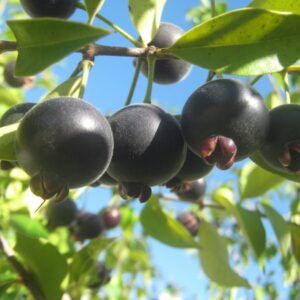
Years of patient cultivation in Melbourne: an established Pacuri beside a pond, a six-year-old Guabijú that has flowered, and an Achacha beginning a new chapter nearby.
One of the most rewarding parts of working with rare-fruit growers is hearing what happens to their trees over the years. Paul, the gardener behind Urban Bounty in Melbourne, Australia, has shared a particularly encouraging account: unusual fruit trees becoming established in a garden with winter frosts, cold winds and hot, dry summers.
His photographs show the actual plants. His observations bring the story to life—and offer useful details for other growers working with challenging conditions.
A Pacuri at the End of a Zone 9b Winter
Paul has been growing this Pacuri for approximately five to six years. It is established in the ground beside a pond, in a garden he describes as zone 9b. The photograph he shared in early September 2026 shows its foliage at the end of the Southern Hemisphere winter.
One observation especially caught our attention: Paul says he has not seen it drop a single leaf during those years, including the first two leaves it produced when it sprouted. That is his observation of this individual tree, and a memorable part of its cultivation history.
He also finds it an excellent plant for the edge of his pond. The pond-side position was chosen to help provide a more humid setting around the trees.
The result documented here is successful establishment and continued growth over several years. Fruiting of this Pacuri has not been reported.
Filtered Light and Protection from the Afternoon Sun
Paul’s latest practical advice concerns light. In his experience, this Pacuri appreciates protection from the hottest afternoon sun and grows best under shade cloth or dappled light.
He adds that its preferences may change as the tree gets larger. For now, filtered light and its position near the pond form part of the setting that has worked for him.
The Garden Conditions Paul Reports
These details describe Paul’s garden and local conditions as he reported them. The temperatures are site figures, rather than measurements of the exact exposure experienced by each sheltered tree.
| Factor | Paul’s report |
|---|---|
| General location | Melbourne, Australia |
| Growing zone | Approximately zone 9b, as described by Paul |
| Original soil | Heavy clay |
| Soil preparation | Purchased sandy loam added above the existing clay, which was left underneath |
| Average soil pH | Approximately 6–7 |
| Annual rainfall | Approximately 700 mm, falling mainly in winter |
| Annual chill hours | Approximately 800–1,000; calculation method not specified |
| Frost frequency | Approximately 15–20 frosts per year |
| Lowest temperature reported | Approximately −3 °C |
| Highest temperature reported | Approximately 46 °C |
| Winter challenge | Strong, cold winds |
| Summer challenge | Hot, drying winds and a marked lack of humidity |
| Pacuri light exposure | Filtered light or shade cloth, with protection from the hottest afternoon sun |
| Planting arrangement | Pacuri and a nearby Achacha beside a pond, positioned with humidity in mind |
To give overseas readers a rough point of comparison, Paul likens his conditions to parts of the San Francisco Bay Area or northern Spain, mentioning Bilbao and A Coruña.
Building Above the Clay
Paul’s starting soil was heavy clay. He added a layer of purchased sandy loam on top and retained the clay below. This is a useful detail about how he established the garden, especially alongside his reported pH of around 6–7 and rainfall concentrated in winter.
Wind, Summer Dryness and Maturing Trees
When asked about the biggest difficulties, Paul emphasizes cold winter winds and hot, desiccating summer winds, together with low summer humidity.
He has noticed that his plants seem to adapt better as they mature and their trunks become brown and woody. This is a grower’s observation from watching his garden develop. It highlights why recording a plant’s age and stage of establishment can be just as useful as noting the climate around it.
A Six-Year-Old Guabijú That Has Flowered

Paul also shared a photograph of his approximately six-year-old Guabijú. In his August 2026 report, he said it had flowered the previous year and might fruit during the coming season.
He reports that this tree survives around 20 frosts each year, with a shorter growing season than in its native range. The established tree and its reported flowering are the milestones we can document so far; fruiting remained an expectation at the time of his message.
First Flowers on the Achacha Nearby
Beside the Pacuri, Paul has an Achacha propagated by air layering. In early September 2026, he reported that it had just produced its first flowers. Both trees were planted near the pond with humidity in mind.
More of the Garden on Urban Bounty
Paul also grows established Lucuma and jaboticabas and has welcomed sharing the stories of those older plants. They offer possibilities for future updates as he supplies their individual cultivation histories.
When he sent these reports, he was preparing a wasabi video in the same pond-side area and intended to show the nearby trees too. You can explore his garden and look for his latest updates on Urban Bounty on YouTube.
Looking ahead, Paul told us that Gardening Australia had approached him about filming his garden in March 2027. At the time of this account, that was a future visit he had described to us.
Why Sharing These Experiences Matters
For Huertas Urbanas, a story like this has lasting value. Keeping unusual fruit trees in cultivation takes patience, observation and a willingness to learn from each plant. Sharing the details helps other growers understand what has worked in one real garden.
Paul asked for nothing in return for contributing his experience. As he put it:
“I just love talking about and sharing my experiences in this hobby.”
— Paul, Urban Bounty
We hope his account encourages more growers to document their trees over the years: their age, site, soil, light, setbacks, flowering and eventual harvests. Those records can help build practical knowledge around rare fruit diversity and its continued cultivation.
About this account: Based on Paul’s written reports and original photographs from August–September 2026, shared with permission. Photographs: Paul, Urban Bounty, Melbourne, Australia. Climate figures and plant observations are grower-reported. A future update may add details of watering, feeding, mulch, pruning and frost protection. This individual experience does not establish universal hardiness limits.
More of the Garden on Urban Bounty
Paul also grows established Lucuma and jaboticabas and has welcomed sharing
the stories of those older plants. They offer possibilities for future updates
as he supplies their individual cultivation histories.
When he sent these reports, he was preparing a wasabi video in the same
pond-side area and intended to show some of these trees as well.
Follow his rare-fruit growing experiments, established trees and new updates
on his YouTube channel, Urban Bounty.