The Guaviyú (Myrcianthes pungens) is a South American fruit tree native to southern Brazil, northern Argentina and Uruguay, thrives well in wet subtropical weather supporting frost up to maybe -10 º C. They say that in tropical climates it does not fruits as good as here.
We found an old tree in Federal Capital (Buenos Aires, Argentina) that allowed us to learn a little about its taste.

(Guaviyú in my garden, 2 years old)
While I have planted a guaviyú of perhaps 5 years old and I have others 2 years in pots, the reality is that the production of the Guaviyús begin a little later, between 4 and 10 years. As anxious as I am, I chose to taste the fruits of this other plant of Buenos Aires. Turned out to be very nice, especially the pulp. In general, I can say that its taste is not “no big deal”, but it has nothing to envy to other fruits like blueberries, and perhaps it could be as tasty as a grape if selected and cultivated better.

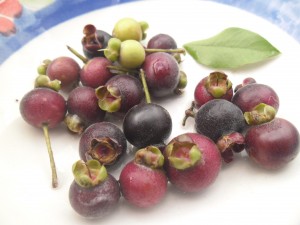
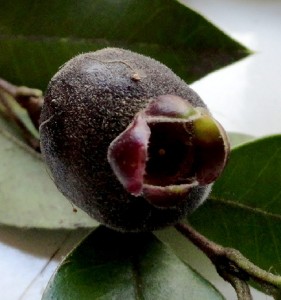
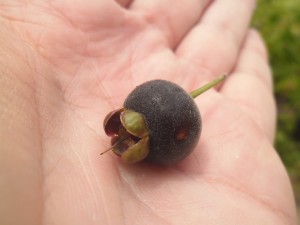
As its name implies in Guaraní, the fruit has a delicate fuzz, and if you rub is a little shiny
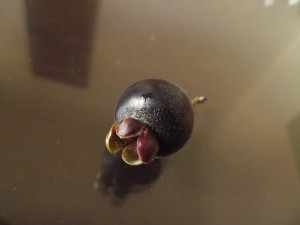
That “crowned” we see on one end, I would say “do not eat”, not because they are not tasty, is that it is too bitter and has a very strong flavor, similar to the leaves of a eucalyptus. The skin also is bitter and has the same aroma / flavor, but not bad at all. It happens that, at least for me, the pulp alone without skin is more pleasant. But there would be nothing wrong in jams, juices and such preparations.
In this case we could say that it lacked a bit of sweetness to the fruit, but it is true that there is not a fertilized tree but a plant that was left “to the good of God”, and secondly we must clarify that given variability presented by guaviyús, we can not stay only with this taste for a final conclusion.
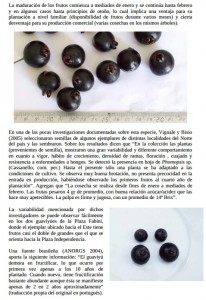
The fruits are also very small, there are twice the size copies, as we see in this publication :
I have to say that the taste of the flesh is great and I loved that the shell is not bad, but at it has little pulp, if you eat shell and all, at the end prevails over the pulp.
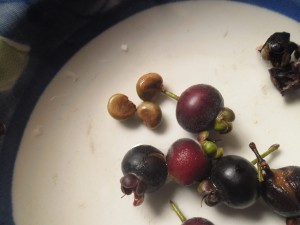
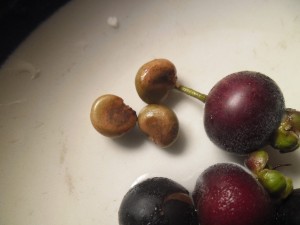

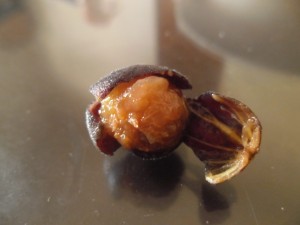
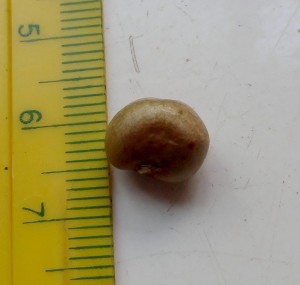
The seeds are small but in the case of harvested fruits occupy a big percentage. They say you have to plant them after being soaked 48 hours, and if possible not bury completely since being pioneer species of open woodlands often germinate better with a little light. Germination time is between 30 and 90 days, but most do between 30 and 40.
It’s a joy to finally know that this is a desirable result, and there are studies that said it provides 10 times more antioxidants than blueberries, which for me are not as tasty or pleasant as Guaviyú.

I am in the Far North of New Zealand. My 10 four year old trees commenced bearing from about 4 years. The first 4 bearing trees gave me a poor impression. Lacking in taste, juice and being hard to suck off the seeds. Also an off aftertaste was a problem. The next year another started to fruit, with VERY sweet and juicy fruits indeed. It was worth walking quite a distance to taste. Now I am keen to grow some hundreds of seedlings for making selections of similar quality and hopefully larger fruit. Such a selection would make it equal to jaboticaba but faster to bear fruit. I have grafted some of my sweet guaviyu onto seedlings which was rather easy to achieve. Cheers.
Thanks for your report! Yes: there is a lot of variation in this species! I agree. Most of them are sweet… I just use to wait until the next season and, in most cases, the fruit improves. But yes: there are bad ones too.